
Folding, Flexing and Expanding
... and new texts available for reading before or after Christmas ⋆꙳•❅*🎄*❆•꙳⋆

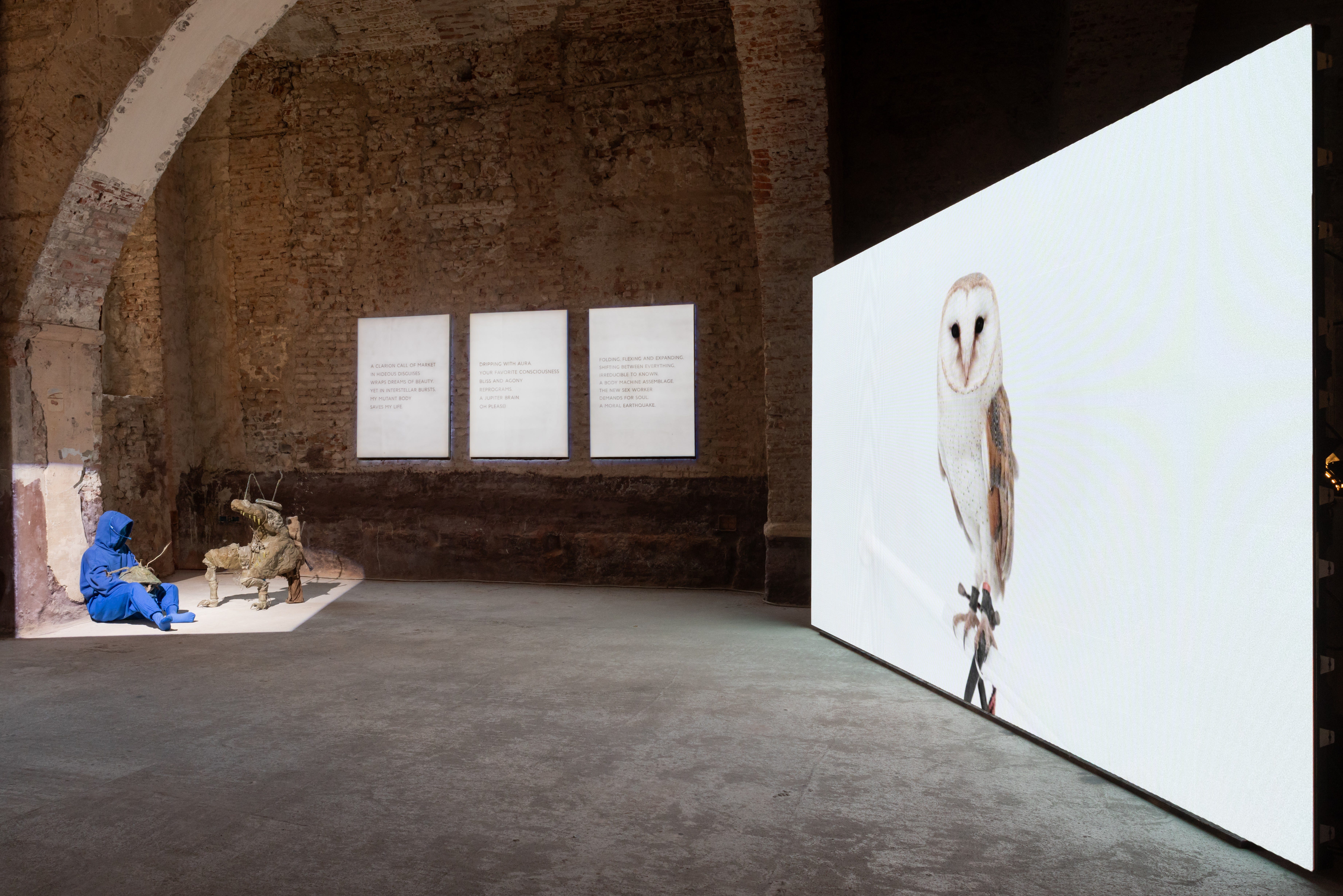
༘⋆ Back in October, thanks to the collaboration and invaluable support of Jessica Bianchera and her team, I had the pleasure to co-curate the exhibition Folding, Flexing and Expanding, the latest instalment of the series “Tomorrows”, focused on speculative futures (Palazzo del Capitanio, Verona, from October 11 to November 9, 2025). The exhibition offered me the chance to collaborate with artists I’ve been admiring for years: Apparatus 22, Zach Blas, Mit Borrás, Shu Lea Cheang, Heather Dewey-Hagborg, Shu Lea Cheang, Michele Gabriele, Copper Frances Giloth. An exhibition guide in Italian and English is available at this link; some installation views below:


✧₊⁺🕯⋆.˚୨ৎ Folding, Flexing and Expanding constitutes an inquiry into the metamorphoses of the body in an era in which technology - from biotechnology to computer graphics, from artificial intelligence to immersive aesthetics - asserts itself not merely as a tool, but as an existential and imaginative infrastructure. The exhibition interrogates how contemporary artistic practices have transformed the body into a terrain of speculative projection and symbolic conflict, a device through which posthuman possibilities, new multispecies alliances, and visual genealogies - spanning from the recent past to still-emerging futures - can be explored. Taken collectively, the selected works delineate a horizon in which the body is no longer a natural given, but an imaginative and political device, continuously reshaped by the technologies, aesthetics, and narratives that permeate it. The exhibition invites viewers to consider diversity not as an exception, but as the foundation of a new hybrid humanism, in which art serves as a critical laboratory for exploring that which has yet to exist and for questioning, with radicality and urgency, the forms that life may take.
゛ ⸝⸝.ᐟ⋆ I’m in my teaching semester and I have a little time for anything else than updating syllabi and reviewing projects and drafts, but lukily in this hyper-accelerated reality, books are still extremely slow to get published, so things that I’ve been writing along the last year and an half are turning ink on paper only now, or not yet.
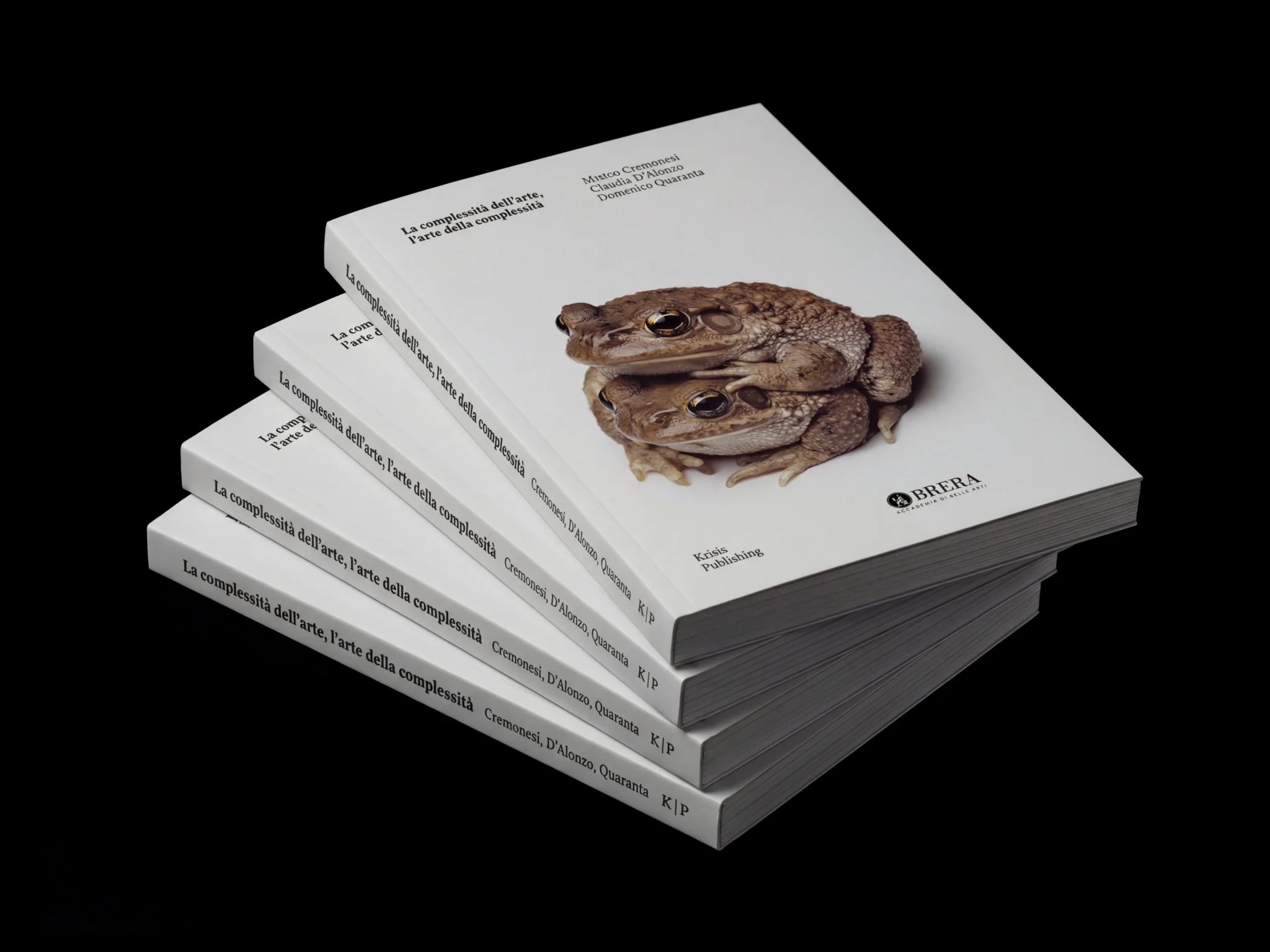
To begin with, I’m extremely proud of a publication I co-edited with my collegues at the Accademia di Belle Arti di Brera, Matteo Cremonesi and Claudia D’Alonzo. Started as a seminar, La complessità dell’arte, l’arte della complessità has been turned in a gorgeous book by Krisis Publishing. In terms of writing, I did little more than adapting into Italian an essay already available in English, about the mechanical gaze and the view from above; but there is much more food for the brain out there.
What does it mean to make art in a world shaped by invisible networks, opaque technologies, and ever-evolving systems? This book gives voice to artists, writers, and researchers who have explored the contemporary landscape through the lens of complexity. From the network as a new space for artistic action to the challenge of agency in the age of algorithms; from dialogues between art and science to radical pedagogies that rethink bodies and ecologies: the volume weaves together critical perspectives and original insights into some of the most urgent issues of our time.
Featuring contributions by Filippo Andreatta, Federico Bomba, Vuk Ćosić, Régine Debatty, Andrea Facchetti, Attila Faravelli, Marialaura Ghidini, Ippolita Collective, Rachele Maistrello, Marco Mancuso, Andrea Daniele Signorelli, and Noura Tafeche, along with essays by the editors, the book offers a rich and multifaceted map for navigating the intricate relationship between artistic practices and the contemporary world.


>⩊< At the Unframing Knowledge: Artistic Research Beyond Theory and Practice in Naples, last October I presented a paper titled “The Chimera and the Brush: On Artistic Research, Tactical Resistance, and the Politics of AI”. The paper, soon to be published in the conference proceedings, draws on pioneering artistic projects such as ImageNet Roulette, Taking Stock, and xhairymutantx to illustrate tactical engagements with AI’s latent spaces that challenge dominant paradigms. These interventions reveal the exploitative dynamics of AI ecosystems, in which users are simultaneously consumers, resources, workers, and products. By invoking Michel de Certeau’s concept of tactics versus strategies, I advocate for a critical, tactical artistic practice that resists corporate AI logics, reclaims agency, and fosters new modes of cultural and political engagement. Situating AI as a political technology – an extension of longstanding systems of control and coloniality – this analysis calls for nuanced critical approaches that demystify its workings and envision alternative “stacks” grounded in autonomy, ethical responsibility, and creative resistance. The full draft is available for download from this link.
( ꩜ ᯅ ꩜;) Similar concepts are at the core of my contribution to two upcoming publications, one in Italian and the other in English. I will provide more details in future newsletters, but I drop the links and covers here as a teaser: Franco Alberto Cappelletti, Luisa Simonutti (Eds), Mirabili artefatti. Arte e pensiero nell’epoca dell’AI, Mimesis, 2025. Italian, ISBN: 9791222323107, pp. 194. With texts by Franco Alberto Cappelletti, Ester Fuoco, Marco Maggesi, Riccardo Notte, Domenico Quaranta, Luisa Simonutti; Pietro Conte, Anna Caterina Dalmasso, Maria Giulia Dondero, Andrea Pinotti (Eds), Algomedia. The Image at the Time of Artificial Intelligence, Springer Cham, 2026. English, ISBN 978-3-032-08725-6, pp. 466 (Upcoming January 2026)
꩜ .ᐟ If you can read Italian, you can already add to your cart TECNO-KITSCH. La spettacolarizzazione digitale, edited by Giulio Lughi. The volume brings together the papers presented at a seminar organized by the Insula Felix Foundation ETS, with contributions from scholars of semiotics and media studies, art historians, artists, and cultural sociologists. Its aim is to address the issue of aesthetic evaluation in the heterogeneous field of digital art, where novelty is often appreciated simply for its technological character. With contributions by Aldo Colonetti, Ruggero Eugeni, Kamilia Kard, Giulio Lughi, Gabriele Marino, Ugo Volli and yours truly, the seminar and the book allowed me to upgrade my first take on digital kitsch with some new considerations on artificially generated imagery, under the headline “The Artificial Empire. Notes on Digital Kitsch”. If a publisher is lurking, this book - spanning from future pasts (Volli) to metaverses and AI (Lughi), from Superman to Veermer (Eugeni), from mukbang (Marino) to digital cuteness (Kard) - would definitely deserve an English translation, and a better cover indeed. We’re Eco’s and Dorfles’ garden gnomes, after all.